Zernike Indexing
The Zernike polynomials are set of 2D basis functions on the unit disc, denoted commonly by \(Z_l^m\). They are indexed by 2 variables, \(l\) is the radial mode number and \(m\) is the poloidal mode number.
The input parameter M in the DESC Input File governs the maximum poloidal resolution, with \(m \in [-M,-M+1,...,M-1, M ]\). Because of the nature of the Zernike polynomials, the radial resolution is inherently coupled to the poloidal resolution, so they cannot be specified completely independently. Instead, the integer parameter delta_lm along with the string zern_mode controls how the radial resolution relates to the poloidal resolution.
The indexing of the Zernike polynomials can be visualized as a pyramid, with the vertical direction corresponding to increasing radial resolution, and the horizontal direction to increasing poloidal resolution, as shown below:
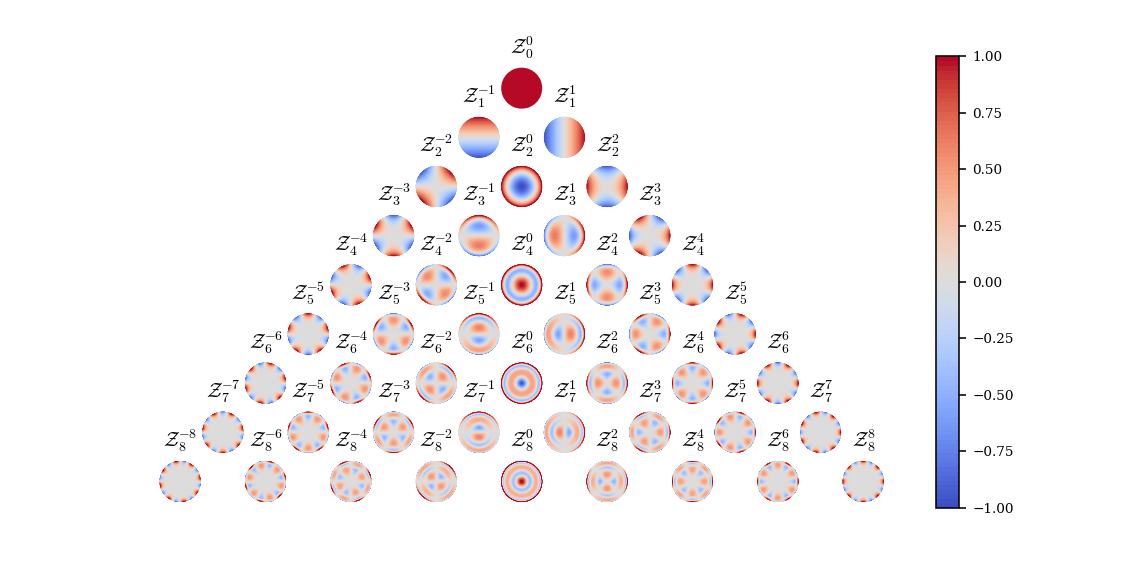
“Pyramid” of Zernike polynomials
All indexing schemes are the same for delta_lm = 0, beginning with a chevron of width 2*M along the outer edge of the pyramid containing the \(l = \pm m\) modes.
The different indexing schemes control how the pyramid is filled in for a given value of M and delta_lm:
fringefills in by adding additional chevrons, decreasing the width by 2 each time, increasing the maximum radial resolution but including only 1 mode at the maximum poloidal resolution of \(\pm M\), and finally forming a diamond shaped pattern whendelta_lm = 2*M. Increasingdelta_lmbeyond this point has no effect. If not specified,delta_lmdefaults to2*M, giving a diamond shape. Also known as “University of Arizona” indexingansifills in with chevrons that decrease in width by 4 each time, and finally forming a pyramid shape fordelta_lm = M. Increasingdelta_lmgreater thanMhas no effect. If not specified, the parameterdelta_lmdefaults toM, giving a pyramid shape.chevronfills in by adding chevrons of constant width, thus giving more modes at the maximum poloidal resolution. If not specified, the parameterdelta_lmdefaults toM, giving a stacked chevron shape.housebehaves likeansi, but increasingdelta_lmadds new modes like levels on a house (adding all modes of a given \(l\) at a time). If not specified, the parameterdelta_lmdefaults to2*M, giving a “house” like shape, hence the name.
This behavior is summarized in the figure below, showing the basis functions used for M = 4 for the different indexing schemes and different values of delta_lm
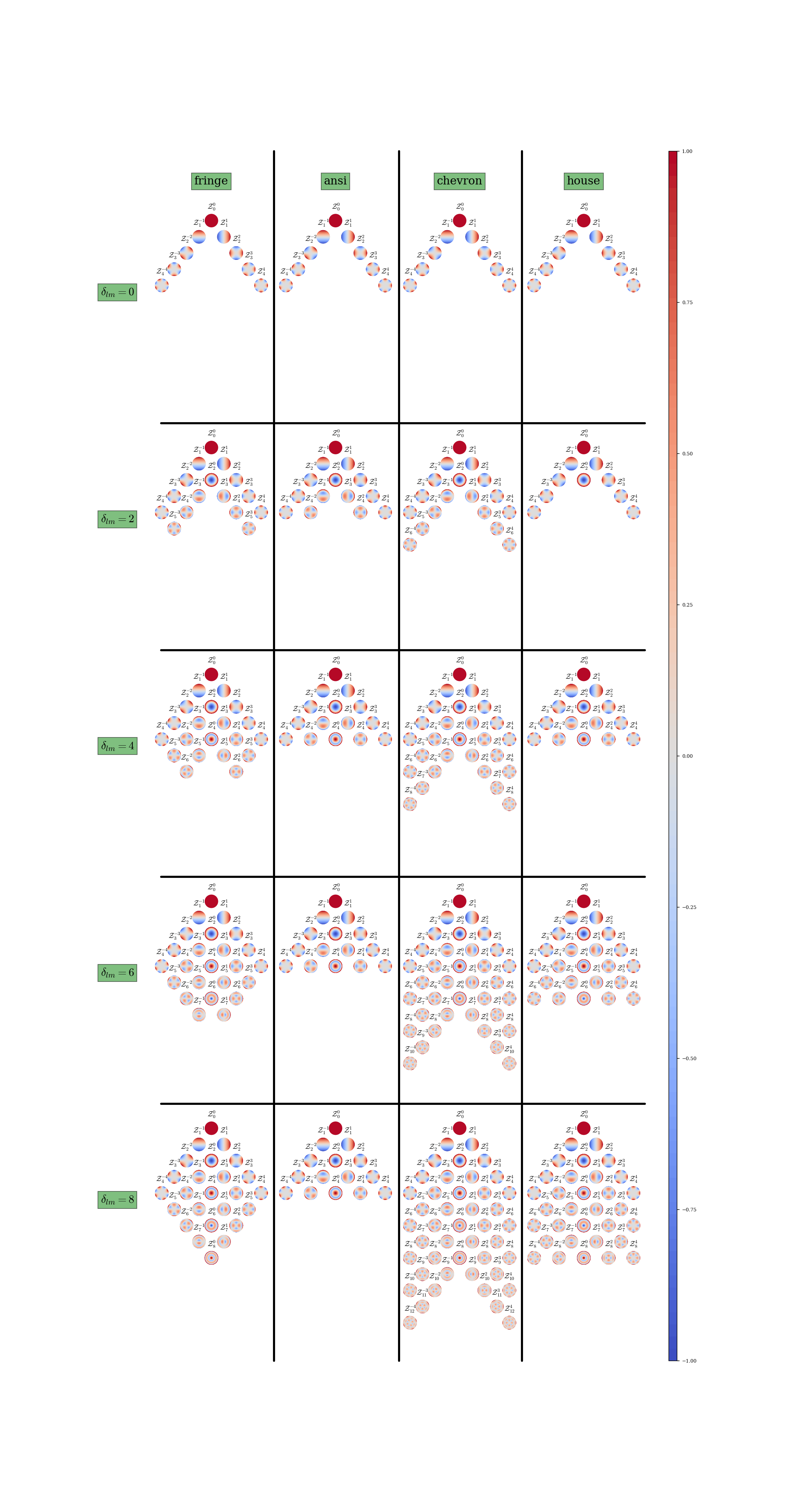
Different indexing schemes for Zernike polynomials